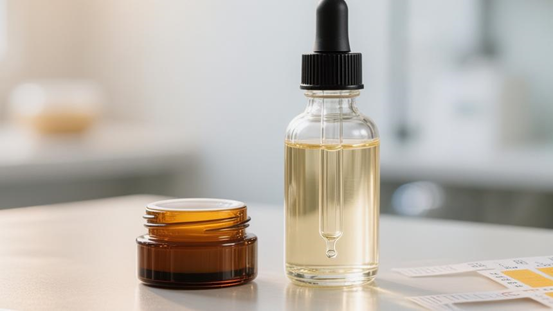
Ascorbyl Tetraisopalmitate (referred to as VcOS) is a highly stable, oil-soluble Vitamin C derivative.
It overcomes the disadvantage of traditional water-soluble Vitamin C being easily inactivated, remaining stable against light and heat, and offering excellent transdermal absorption: experimental data show that at a concentration of 20μM, its intracellular content of free Vitamin C is 50.92 times that of ordinary Vitamin C.
Its core benefits are efficient whitening and anti-oxidation.
Experiments show that 0.2% VcOS can reduce melanin production by more than 80%; clinical tests with a 2% addition level show it can significantly reduce the skin's melanin index (melanin index(MI) decreased from 220 to 183).
VcOS is friendly to sensitive skin, with a recommended formula addition level of 0.1%-5.0% (pH < 6). It is widely used in cosmetics such as face creams, sunscreens, and essences.
Benefits
At a concentration of 20μM, its intracellular absorption is more than 50 times that of ordinary water-soluble VC.
With an addition of only 0.2%, it can reduce melanin by more than 80% in vitro.
After 30 women used products with a 2% concentration continuously, skin brightness (L*) and skin tone clarity (ITA°) both showed stable improvements.
Additionally, after applying a 10% concentration gel for 1 to 3 months, over 50% of acne problems were alleviated.
Whitening and Skin Tone Brightening
In terms of improving pigmentation, in vitro test data shows that 0.2% concentration of VcOS can directly reduce melanin production by more than 80%.
In clinical observations of 30 women, subjects used products containing 2% VcOS daily.
Instrument measurement results showed that skin brightness (L*) values and ITA° values representing skin tone clarity showed a stable upward trend, while the measured MI significantly decreased.
Observation Environment | VcOS Test Concentration | Specific Data and Indicator Changes Recorded |
In vitro test | 0.2% | Melanin production directly reduced by over 80% |
Clinical observation (30 women) | 2.0% | Skin brightness (L*) and skin tone clarity (ITA°) increased, melanin index (MI) decreased |
Antioxidant and Protection Against Photo-damage
In cellular-level antioxidant tests, VcOS can promote the expression of Nrf2 antioxidant protein in HaCaT cells, with its expression level ranking first among similar Vitamin C derivatives.
When cells are in environments containing hydrogen peroxide (H2O2) and tert-butyl hydroperoxide (t-BHP), a significant cytoprotective effect can be observed with the addition of VcOS.
In UV irradiation tests, VcOS effectively resisted cell damage caused by UV; in a UVB irradiation environment, its cell protection data was superior to traditional water-soluble Vitamin C.

Collagen Synthesis and Acne Skin Repair
Benefiting from its oil-soluble structure, at a concentration of 20μM, when VcOS contacts skin fibroblasts, the free Vitamin C content detected in the cells is more than 50 times that of the water-soluble VC treatment group at the same concentration.
This high concentration of free state helps promote collagen synthesis, manifested as improved skin firmness and elasticity, and a reduction in the number of wrinkles.
In clinical assessments for acne-prone skin, 20 subjects with acne used a gel containing 10% VcOS.
After continuous application for 1 to 3 months, most subjects achieved an improvement rate of over 50% for their acne problems.
Daily Use Scenarios
As a skincare raw material, 0.1% to 5.0% is the conventional recommended addition amount in formulas.
It is stable to heat and light and does not rely on extremely low pH environments, so it is friendly to sensitive skin and less likely to cause stinging when applied.
It is completely miscible with various cosmetic oils and is currently widely added to the following types of daily products:
Basic moisturizing products such as masks and lotions
Local repair products such as face creams and eye creams
Body care products such as shower gels and essential oils
Base makeup and sunscreen products such as sunscreens and foundations
Uses
Ascorbyl Tetraisopalmitate (VcOS) is mainly used as an oil-soluble whitening and antioxidant ingredient in skincare products.
It can be directly dissolved in cosmetic oils and added to formulations such as face creams, essential oils, sunscreens, and foundations.
The conventional recommended addition amount is 0.1%-5.0%.
Clinical whitening test concentrations are usually at 2%, and the concentration of gels for adult acne reaches 10%.
During production, ensure the system pH is below 6.
It should be added at the final stage of the process, along with chelating agents and antioxidants to maintain formula stability.
It achieves the effects of spot fading, UVA/UVB photo-damage prevention, and acne improvement by inhibiting tyrosinase and activating Nrf2 protein.
Production Formula
In actual formula production, the pure oil-soluble property of VcOS makes its processing method different from that of ordinary water-soluble Vitamin C.
The following are the specific restriction indicators and operation requirements in formula applications.
Formula Requirement | Specific Data and Operation Details |
Addition Concentration | Add 0.1% - 5.0% for daily care products; use 2% for whitening test formulas; use up to 10% for adult anti-acne gels |
pH Environment | The pH of the processing system must be kept below 6 |
Feeding Timing | Must be added at the last stage of the production process (before formula adjustment) |
Matching Ingredients | Chelating agents and antioxidants need to be added to the formula simultaneously to maintain the stability of the overall formula |
Applicable Dosage Forms and Product Types
Because of its good stability to light and heat and low skin irritation, VcOS is formulated in various daily cleaning and makeup products.
Oil-based and emulsified products: Including essential oils, face creams, eye creams, and body lotions. It can be directly integrated into cosmetic oils with a high transdermal absorption rate.
Protection and base makeup products: Added to sunscreens to resist epidermal cell damage caused by UVA and UVB; added to liquid foundations to provide antioxidant protection and reduce the dullness and yellowing of the base makeup after contact with air.
Washing and patch products: Used in smear or patch masks, as well as shower gels, as a local brightening ingredient for the body or face.

Action Direction
From clinical test data, the specific uses of VcOS correspond to the following clear skin intervention directions.
Inhibition of melanin production: Data shows it can reduce intracellular tyrosinase activity and block the melanin synthesis pathway. It shows spot-fading and skin-brightening effects in tests at 2% concentration.
Antioxidant protection: Stimulates the expression of Nrf2 antioxidant protein in the skin, reduces the destruction of cells by hydrogen peroxide (H2O2) and free radicals, reduces wrinkles, and maintains skin firmness.
Alleviation of facial acne: Continuous use of products containing VcOS (such as the 10% concentration gel test) has a significant improvement effect on adult facial acne.